
GOMicroClimatt: highlighting the role of microalgae biostimulants for more sustainable agriculture

The agricultural sector has recently had to demonstrate its essential role in guaranteeing the supply of food to society, with a global population that is also growing at a rate never seen before. However, our farmers face all kinds of growing challenges, and a notable one is climate change.
In this framework, biostimulants are increasingly playing a leading role in agricultural production. The contribution of biostimulants to agriculture is already relevant, and the forecast is that their market will quadruple between 2020 and 2030 worldwide. It is expected that they will continue to contribute to a more profitable and sustainable agriculture, increasing the competitiveness of countries that are committed to export-quality production, as is the case of Spain. Likewise, it is expected that they will help produce more with less, by reducing the use of nitrogen and other chemical elements, which is closely aligned with the "Farm to Fork" Strategy of the European Commission, which has set the objective of reducing of the 20% of fertilizers and a 50% of phytosanitary products until 2030.

Valuing the essential role of agricultural biostimulants, and specifically those made from microalgae biomass, is the objective of the MicroClimatt Operational Group, which seeks to demonstrate the effectiveness of innovative biostimulant solutions derived from microalgae that manage to efficiently combat the effects of climate change in crops such as tomatoes or wheat. MicroClimatt will evaluate in these crops the effects that at a physiological and transcriptomic level are induced by treatment with novel microalgae biostimulants, including conditions that are caused by climate change directly or indirectly, such as situations of water stress or deficient fertilization rates.
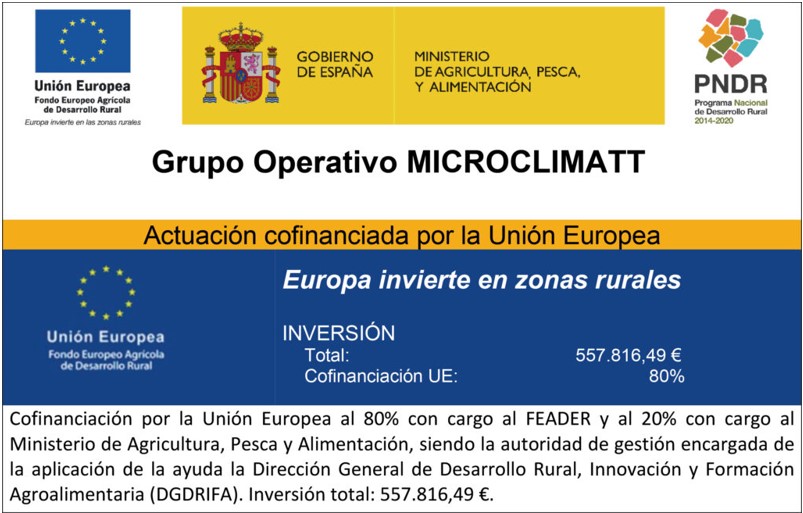
The MicroClimatt Operating Group, with a budget of 557,816.49 euros, is co-financed by the European Union to 80% from the European Agricultural Fund for Rural Development (EAFRD) and 20% under the Ministry of Agriculture, Fisheries and Food, with the managing authority in charge of applying the aid being the General Directorate of Rural Development, Innovation and Agri-Food Training (DGDRIFA). The project is promoted and coordinated by AlgaEnergy, an international leading company in the sector of microalgae biotechnology and its applications, and has top-level members such as the Institute of Plant Biochemistry and Photosynthesis (IBVF) of the University of Seville , the Madrid Institute of Rural, Agrarian and Food Research and Development (IMIDRA), the Segura Center for Soil Science and Applied Biology (CEBAS-CSIC) and the Agrarian Association of Young Farmers (ASAJA). Likewise, BIOVEGEN – Plant Biotechnology Technological Platform will be in charge of coordinating valorization and dissemination activities.
In addition to evaluating the improvement of resistance to water stress and nutrient utilization efficiency in tomato and wheat crops treated with microalgae biostimulants, the MicroClimatt Operational Group also aims to quantify the incorporation of carbon into plant biomass. of crops linked to increased productivity, evaluate the increase in the incorporation of organic carbon in the "soil sink" and study the improvement in edaphic fertility of soils due to the effect of treating crops with derivatives of microalgae, as well as the improvement of the quality, functionality and sustainability of the floor.

About AlgaEnergy
AlgaEnergy is a biotechnology-based company specialized exclusively in the microalgae sector. The company consolidates the deep knowledge that exists in Spain in the science of microalgae, generated by universities and other research centers over the last 5 decades. With a strong investment in R&D&I, it has positioned itself as the international reference in this field. AlgaEnergy's mission is to develop and market innovative and high-quality solutions, based on microalgae, that are aimed at responding to the specific needs in different industries.
About IBVF
The Institute of Plant Biochemistry and Photosynthesis (IBVF) is a Joint Center of the University of Seville and the CSIC, which aims to study the biology of photosynthetic organisms responsible for the primary production of organic matter and oxygen in the biosphere. A singularity that distinguishes the IBVF from other centers in the field of biotechnology and plant biology is addressing the study of phototrophic biology in all its complexity, that is, using all types of photosynthetic organisms (cyanobacteria, microalgae and plants). Scientific activity at the IBVF focuses on molecular and cellular biology of photosynthetic organisms, as well as “omic” techniques (transcriptomics, proteomics, metabolomics) and big data analysis.
About CEBAS
The CEBAS-CSIC seeks to contribute, through research, to generating the necessary knowledge that allows developing strategies to achieve the Sustainability of the fragile resources existing in semi-arid areas, managing them correctly and making possible in that environment, the development of a sustainable agriculture. quality and obtaining healthy and safe plant foods. The research carried out will help to address problems such as water scarcity, provide a better environment (reduction of the greenhouse effect, conservation of soil and vegetation, as well as organic matter and carbon), thus guaranteeing sustainable, intelligent agriculture, and adapted to climate change, with the capacity to mitigate it.
About IMIDRA
The Madrid Institute for Rural, Agrarian and Food Research and Development (IMIDRA) is the public research organization of the Community of Madrid to carry out R&D actions and support innovation in the primary sector and its associated industry. It has 8 farms and facilities to implement R&D, pilot projects and demonstration activities, perform analysis services, disseminate and display its results, offer training, and facilitate the transfer of R&D results. In MicroClimatt participates through Agri-Food R&D Department.
About HANDLE
Asaja (Young Farmers Agrarian Association) was created in 1989 as a result of the merger agreement of CNAG, CNJA and UFADE. It is a professional agricultural organization in Spain, with more than 850 offices spread throughout the national territory. It has a National Headquarters located in Madrid, 15 Regional centers, 40 provincial offices and 810 local offices, as well as a permanent representative office in Brussels. Asaja is established for the representation, management, defense and promotion of the professional interests of the agricultural sector in general and its member organizations with full legal personality and subject to strictly democratic principles. As a national organization with a general vocation, it integrates within it all branches of agricultural activity in its agricultural, livestock, forestry, environmental management and hunting activities. The national office is made up of a technical department (each specialized in a specific subject), labor-fiscal department, communication department and the training department.
About BIOVEGEN
BIOVEGEN-Plant Biotechnology Technology Platform is a public-private partnership currently made up of 145 partners (companies and research/technological centers) working on agrobiotechnological innovation. The objective of BIOVEGEN is to promote R&D&I activities in science-business collaboration, offer R&D management services and facilitate the business development of its associates through plant innovation. BIOVEGEN is supported by the Ministry of Science and Innovation.
«Responsible for content: MICROCLIMATT Operational Group»
 English
  Spanish