


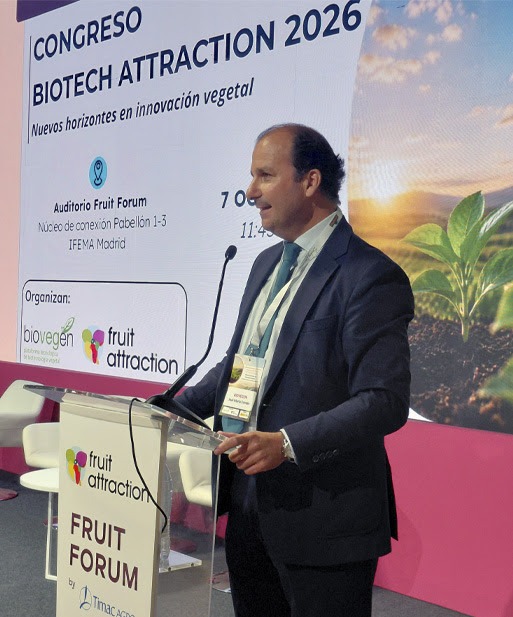
- The Biotech Attraction Congress has solidified its status as the most multidisciplinary knowledge event of the fair, filling the Fruit Forum hall with more than 400 researchers, technicians, and companies related to agriculture. A record 207 business-to-business meetings were arranged since 2015
- During the congress, it was confirmed how AI will allow us to “move from observation-based variety improvement to prediction-based improvement,” but it “will not replace” the role of the breeder (the developer) and will instead “reduce the time and uncertainty” regarding new developments
- Spanish research centers -such as IRNAS-CSIC (Sevilla), CNTA (Navarra), AINIA (Valencia), or the Medina Foundation (Granada)- showcase their focus and great potential in new developments in agricultural biotechnology
Madrid, 15-10-2026.- Biovegen is a public-private platform made up of nearly 200 companies and research centers whose activity is to facilitate technology transfer in agricultural biotechnology to boost the competitiveness of this sector. Hence, for more than a decade now, it has been interested in participating and being an active agent in the largest horticultural fair in Europe and probably one of the largest reference fairs in the world, Fruit Attraction (at Ifema, from October 6 to 8). Well then, once this latest edition concluded, Biovegen has assessed its contribution. Indeed, the Biotech Attraction Congress that it promotes every year has established itself as the most multidisciplinary knowledge event of this major event and managed to fill the Fruit Forum again, but this time with more than 400 researchers, technicians, and entrepreneurs, the largest attendance of all its editions. But, just as important, it managed to double the number of science-business contacts achieved in 2025: ultimately, Biovegen facilitated that during the fair there were up to 207 meetings, also a record since 2015, meetings motivated to explore collaboration for implementing a biotechnological innovation. For Biovegen’s president, José María Fontán, such figures are a direct reflection of “the great expectations created both by the recent European regulation of New Genomic Techniques (NGT’s) -whose regulation partially came into force in July- and by the own still nascent developments and applications of Artificial Intelligence (AI) in variety improvement processes,” which was one of the main attractions to be addressed in this meeting.
Aware of the key moment the sector is experiencing and the growing projection of this forum, it was the director of Fruit Attraction, Maria José Sánchez, who wanted to take on the formal inauguration and personally congratulate Biovegen for its ability to gather people. The closing, for its part, was conducted by the general director of Agricultural Productions and Markets of the relevant ministry, Elena Busutil, who took the opportunity to emphasize, in this same vein, how NGTs, new generation fertilizers (biostimulants), and industrial biotechnology ‘are topics that (now) are at the forefront of the EU political agenda,’ with the next step being the regulation of genetically edited microorganisms.
Beyond the disruptive impact that these European regulations imply, biotechnology in general and techniques for genetically editing plants like CRISPR in particular will also be propelled by the frantic development of Artificial Intelligence (AI). One of those disruptive Spanish companies, Ploid AI Biotech, exemplifies this; its CEO and young founder, Federico Jurado, made it very clear how rapidly advancements are occurring: “The benchmarks (which are tests that measure and compare the performance of different AI models on specific tasks) that used to take years to surpass now fall within months.” This potential, combined with the almost equally rapid development of bioscience – sequencing a human genome cost about 100 million dollars in 2021 and can now be done for less than a thousand – allows us to predict that AI will soon contribute to accelerating the processes of variety improvement. The services for analyzing omics data (which are large sets of information of interest regarding a plant) offered by this pioneering company provide researchers, a priori, with models to predict the effects of variants, the functionality of certain genes, and the broad interactions among them. In short, as Jurado explained, this platform created through AI allows the researcher-breeder to “make decisions based on reliable data, better control the diversity of plant materials, select which traits are worth pursuing to achieve crosses with higher probabilities of success, and even determine which genes are involved in each trait and thus choose the plant.” “Ultimately,” he said, “it reduces the trial-and-error process of conventional breeding or genetic editing.”
A fact supported by the experience of the R&D heads of one of the most active breeders in red fruits, Berryum and Remo Varieties -Mariana Ochoa- as well as the popular brand La Canastita (from Agrícola El Bosque SL) that markets some of its new varieties of blackberries or raspberries -Jesús Martínez-. From the breeder’s perspective, the first of them predicted that the emergence of AI in improvement processes will evolve from systems based on ‘experience, field observation, and knowledge of the parental plants (the ‘mother and father’ plants that are later crossed to achieve the desired effect) to another based on predictions from data management.’ Ochoa concluded that AI will not only shorten the time for obtaining results but will also ‘reduce the uncertainty about the outcomes,’ although she warned that neither NGTs nor AI -nor the progressively greater understanding of the molecular markers of each crop- will ‘completely replace conventional breeding or the need to test plants in the field.’
Reorientation
New biotechnology techniques, not just NGTs, are making their way into the main research centers of the country. Biovegen wanted to reflect this with the testimony of heads of centers that in recent years have reoriented their activities and services with parallel lines of research and are working in direct contact with companies. This is the case of IRNAS-CSIC (Sevilla), the most focused on agrobiology, which has three large departments dedicated to research on soils and water, plants (seed biotechnology, ionic regulation of plants…) or microbiome (biogeochemistry, environmental microbiology…), with its own technology transfer unit but also developing specific projects with NGTs in plants. AINIA (in Valencia), on the other hand, historically has had a more technological and industrial profile – focused on food safety or quality issues – but is redirecting its knowledge and personnel in microbiology, omics studies, or genetic engineering to European projects – some strictly agricultural, non-food – where they intend to contribute scalable solutions at an industrial level. Finally, the MEDINA Foundation (Granada) has a differential asset: it has around 190,000 microbial strains and a large library of extracts/natural products, and from these seeks molecules, microorganisms, enzymes for the pharmaceutical or cosmetic industry, biological control solutions (not chemical) or biocomponents for agriculture. The case of CNTA (Navarra) deserves a separate chapter as it is deepening in fermentation, not just as the known process for preserving bread, wine, or beer but as an innovation to create ‘designed’ foods, for example, to obtain vegan cheeses (plant-based) with similar aroma, flavor, and texture, or to produce microbial biomass rich in protein.
Regarding technological transfer, advances and results from two projects in which Biovegen participates were discussed: GO PISTABIOTECH (to valorize by-products of pistachios: the pod, shell, and peeling water) and GO VINEURO (which enhances the sustainability and differentiation of wines through ecosystem practices in vineyards, especially the use of aromatic and medicinal plants).
Biotech Attraction
The mentioned congress is its biggest showcase, but Biovegen’s commitment to bringing plant innovation to the primary sector extends with the organization of a fair – Biotech Attraction – that celebrated its seventh edition this year under the umbrella of Innova&Tech. Up to 17 companies and research centers participated as exhibitors. Most of these entities, associated with Biovegen, also had the opportunity to present their projects at the so-called Biotech Forum within this space.
Proof of the high expectations generated in this edition are the mentioned science-business meetings in which this platform mediates: last year, before the fair started, 71 were arranged, in 2026 there were 150, but ultimately all these figures were exceeded while already at Ifema, culminating in the mentioned 207 meetings (180 of them business-to-business and another 27 business-research center).
Read the article at: