


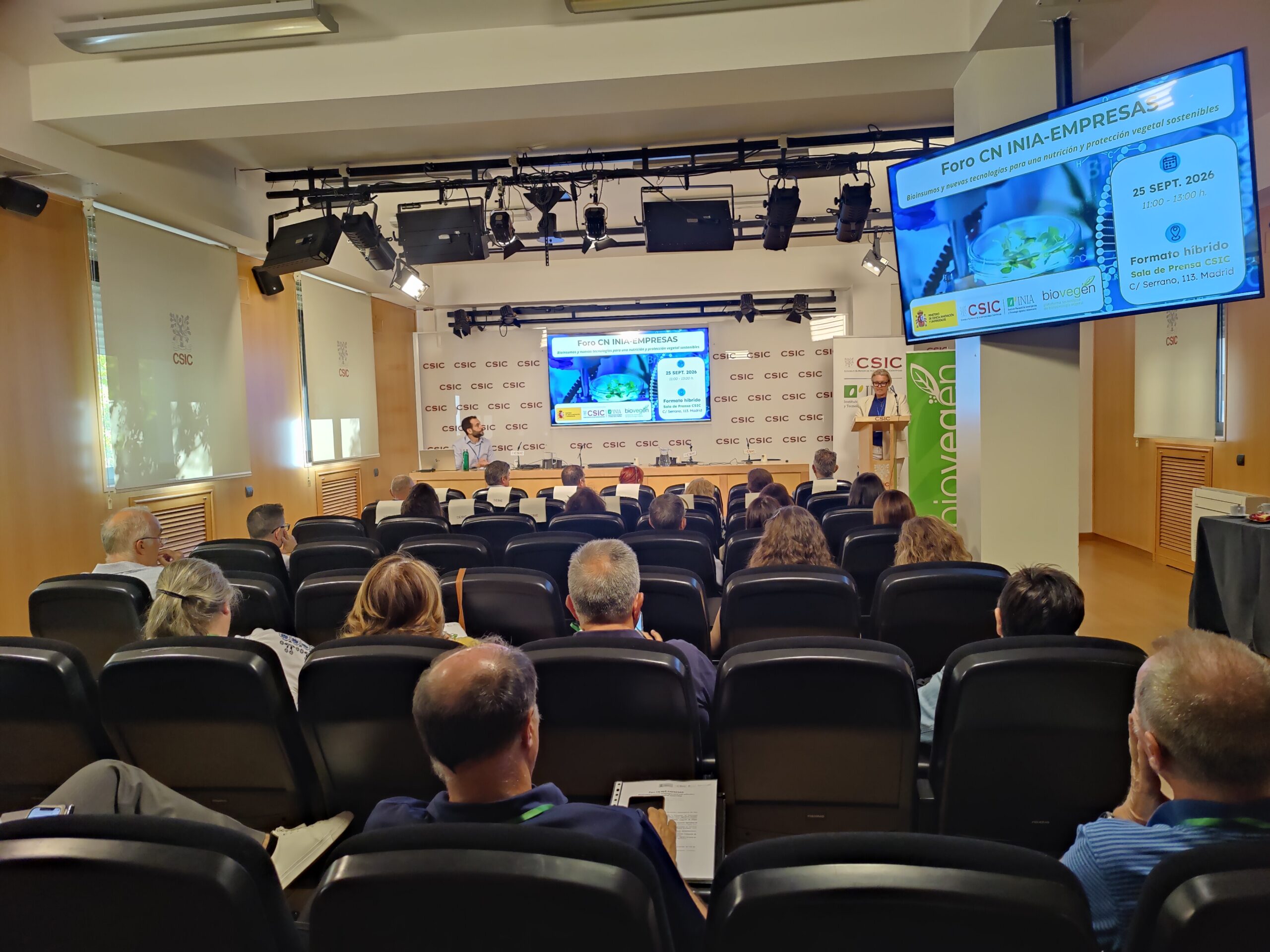
The CN INIA-EMPRESAS Forum: Bioinputs and new technologies for sustainable plant nutrition and protection, organized by INIA-CSIC in collaboration with the Technological Platform for Plant Biology BIOVEGEN and held on September 25, 2026, at the central headquarters of CSIC in Madrid, constituted a meeting space among researchers, companies, innovation entities, and funding organisms with the aim of strengthening the transfer of scientific knowledge towards applicable solutions in the agri-food sector.
The event focused on presenting the scientific and technological capabilities of INIA-CSIC in strategic areas for sustainable agriculture, including microbial bioinputs, biological pest control, precision farming, genomics applied to plant health, evaluation of contaminants, behavior of pesticide residues, and soil health. Additionally, representatives from BIOVEGEN and the CDTI participated, who presented support tools for innovation, public-private collaboration, and financing for R&D business projects.
One of the main messages that emerged during the meeting was the need to build stable collaboration mechanisms between research centers and companies to accelerate the arrival of innovations in the market, favoring both technological development and adaptation to the increasingly demanding regulatory requirements.
To this end, INIA-CSIC showcased its main scientific and technological capabilities to promote collaboration with companies, technological centers, and other players in the innovation ecosystem, aiming to implement sustainable solutions for agriculture and the bioeconomy. During the forum dedicated to bioproducts, INIA-CSIC researchers presented capabilities in biological control, development of health-related bioproducts based on microorganisms, molecular tools for diagnosing plant diseases, strategies for sustainable pest management, precision agriculture, valorization of by-products as fertilizers, and generating knowledge for evaluating new agricultural products. The institute provides support from the initial phases of research through validation, regulatory support, and market transfer. Among the most notable strengths are the development of biopesticides and biocontrol agents, the study of the action mechanisms of pathogens through omics tools, the optimization of production and formulation processes, and generating the knowledge necessary to facilitate their future commercialization.
The INIA-CSIC also has advanced capabilities in plant health, including molecular diagnosis of pathogens, early detection of diseases, evaluation of resistance to insecticides, study of emerging and invasive pests, and the design of sustainable control strategies adapted to the challenges posed by climate change. Precision agriculture is another area with significant potential for collaboration. Research groups develop digital tools based on remote sensing, artificial intelligence, image analysis, and sensors to monitor crops, optimize input usage, and improve productivity. These solutions have demonstrated verified results in reducing herbicide use, improving phytosanitary alert systems, and characterizing and obtaining phenotypic traits. Additionally, the institute has extensive experience in residue studies, environmental behavior, risk assessment, and generation of technical-scientific knowledge to support regulatory processes, a particularly valuable capability for companies developing new fertilizers, biostimulants, phytosanitary products, or circular economy solutions.
During the event, the need to strengthen collaborative projects, innovation consortia, and joint experimentation spaces was highlighted, allowing for the validation of technologies under real conditions, accelerating their scaling, and facilitating their market entry. The INIA-CSIC reiterated its willingness to work with companies and other ecosystem agents from the initial phases of technological development, promoting the generation of innovative, viable solutions aligned with the needs of the agri-food sector. It also invited interested entities to learn about its infrastructures, laboratories, and research teams to identify new opportunities for cooperation and knowledge transfer.
Recording
Program and presentations
10:30 h. Reception and welcome coffee
11:00 h. Welcome and introduction
- Cristina Óvilo, Director INIA-CSIC
11:05 h. Presentations of scientific and technological capabilities of CN INIA-CSIC
- From the lab to the market: development and evaluation of safe, effective, and regulatory-compliant microbial bioproducts. Belén Guijarro Díaz-Otero, Inmaculada Larena Nistal, Dept. of Plant Protection
- Agroforestry Entomology: research on integrated pest management. Manuel González Núñez, Dept. of Plant Protection
- Geo-spatial techniques for the management of inputs through Precision Agriculture and high-yield phenotyping. Ana Isabel de Castro Megías, Dept. of Environment and Agronomy
- From genomics to the field: determinants of pathogenicity in plant pathogenic bacteria and their applications in diagnosis and biological control. Jaime Cubero Dabrio, Dept. of Plant Protection
- Determination of organic contaminants in agro-environmental samples. Beatriz Albero Romano, Dept. of Environment and Agronomy
- Behavior of residues from plant protection products. Risk assessment. Pilar Sandín España, Unit of Plant Protection Products
- Scientific trials to evaluate impacts on plant nutrition and soil health. José Luis Gabriel Pérez, Dept. of Environment and Agronomy
11:55 h. BIOVEGEN. Plant Innovation Ecosystem
- David Lapuente, Project Managers
12:10 p.m. CDTI. Opportunities for funding R&D initiatives in collaboration with companies and research groups
- Carlos Franco Alonso, Evaluation and Guidance Technician for Business Projects
12:25 p.m. Questions and discussion
12:45 p.m. Conclusions and closing
1:00 p.m. Cocktail and networking